
Mitochondrial Biology
The mitochondria are the cell's energy centres and a hub of signalling research — connecting MOTS-c, NAD+ and the carnitine shuttle.
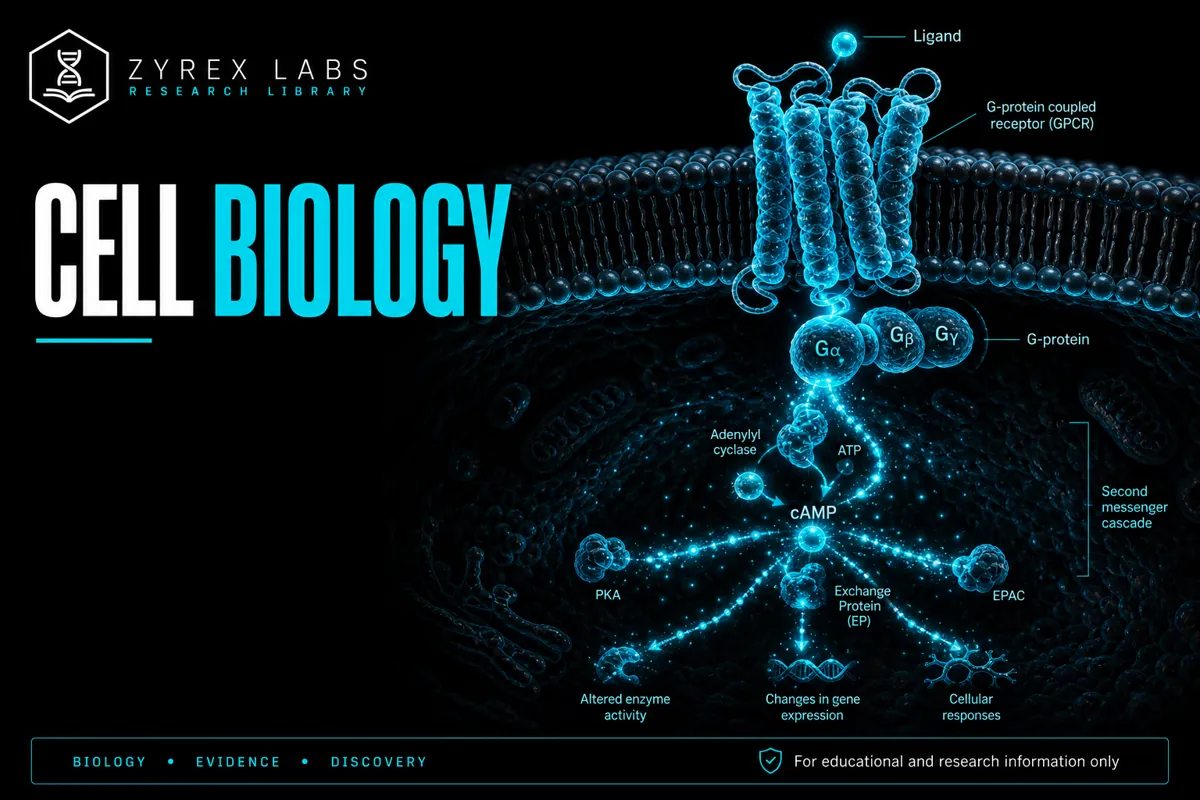
Mitochondria are organelles that generate most of a cell's usable energy.
They carry their own DNA, which encodes mitochondrial-derived peptides such as MOTS-c.
They act as signalling hubs as well as energy producers.
What are mitochondria?
Mitochondria are organelles found in most cells. They are best known as the site of energy production, but they are also studied as signalling centres that communicate with the rest of the cell.
Mitochondrial signalling
Mitochondria carry their own small genome, which encodes peptides such as MOTS-c. Research into these mitochondrial-derived peptides explores how the mitochondria signal to the nucleus and coordinate cellular energy.
Frequently asked questions
Why are mitochondria important in research?+
They produce most cellular energy and act as signalling hubs, making them central to cellular-energy and metabolic research.
Related topics
For laboratory research use only. Not for human or animal consumption.
Continue learning
MOTS-c
A mitochondrial derived peptide studied within cellular energy regulation, AMPK-associated signalling and metabolic adaptation research.
NAD+
A coenzyme studied within cellular redox biology, mitochondrial metabolism and DNA-repair enzyme research.
Cellular Energy: How Cells Power Themselves
An overview of how cells generate, carry and regulate energy — the topic cluster that connects NAD+, the carnitine shuttle and mitochondrial-derived peptides.
L-Carnitine: The Carnitine Shuttle
L-Carnitine is a molecule central to the carnitine shuttle, the system that transports long-chain fatty acids into the mitochondria for beta-oxidation.
Research categories
Featured guides
L-Carnitine: The Carnitine Shuttle
L-Carnitine is a molecule central to the carnitine shuttle, the system that transports long-chain fatty acids into the mitochondria for beta-oxidation.
Cellular Energy: How Cells Power Themselves
An overview of how cells generate, carry and regulate energy — the topic cluster that connects NAD+, the carnitine shuttle and mitochondrial-derived peptides.